

A roofing company can have skilled crews, competitive prices, and excellent workmanship yet struggle to keep its schedule full. The problem often starts with an inconsistent pipeline of qualified roofing leads.
Google identifies relevance, distance, and prominence as the main factors influencing local search rankings. That makes your website, Google Business Profile, and reputation important parts of your lead generation strategy.
This guide explains how to get roofing leads through local SEO, paid advertising, referrals, commercial prospecting, and AI tools. You will also learn how to evaluate lead providers and convert more inquiries into paying customers.
What Are Roofing Leads?
Roofing leads are homeowners, property managers, commercial property owners, or other prospects who show interest in roofing services and provide a way for a contractor to follow up.
A lead might come from a homeowner requesting a roof replacement estimate, a property manager looking for a commercial roof inspection, or a business owner searching for emergency leak repairs.
Not every lead is equally valuable. Someone comparing prices for a roof replacement next month has different needs from a property manager dealing with an active leak today.
Roofing lead generation is the process of attracting these prospects, collecting their information, qualifying their requirements, and moving them toward an inspection, estimate, and signed contract.
A reliable lead generation system should help you:
- Reach property owners within your actual service area.
- Attract projects that match your services, crew capacity, and preferred job size.
- Reduce time spent chasing unresponsive or unqualified prospects.
- Maintain a steady pipeline outside peak roofing and storm seasons.
The goal is not simply to collect more names and phone numbers. It is to generate opportunities that produce profitable roofing jobs.
15 Best Ways to Get Roofing Leads
1. Optimize Your Google Business Profile
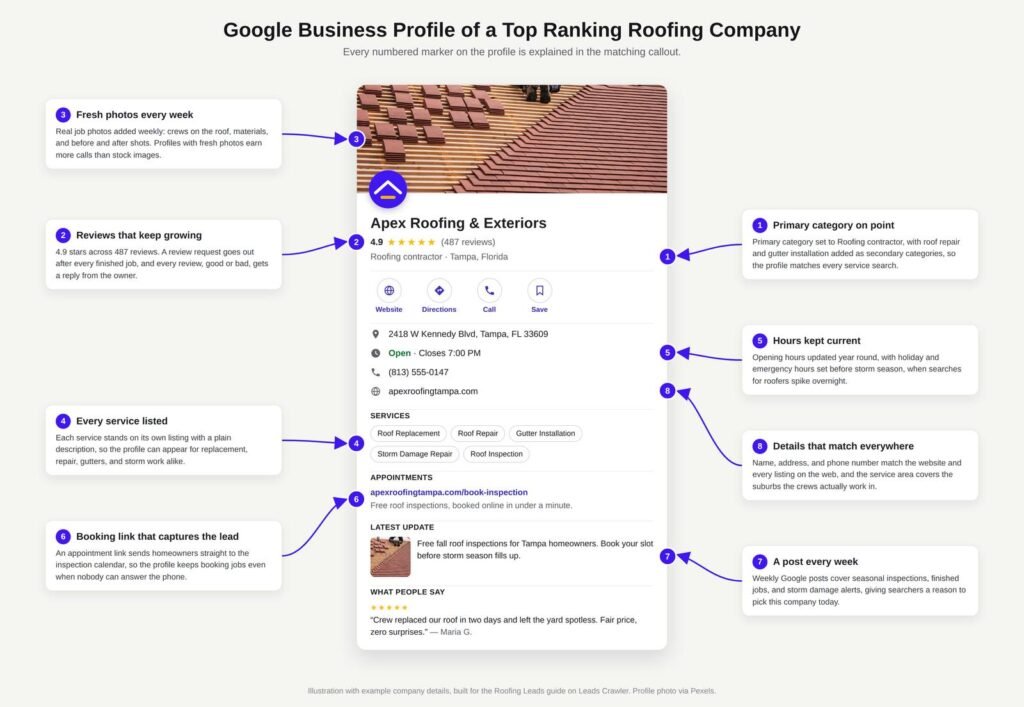
Your Google Business Profile can help your roofing company appear in Google Search and Maps when nearby customers search for roofers, roof repairs, or roof replacement services.
Start by claiming and verifying your profile. Use your actual business name, accurate contact information, correct business categories, and a service area that reflects where you operate.
Next, complete the profile with relevant services, business hours, photos, and a link to your website.
For a residential roofing contractor, useful photos include completed roof replacements, shingle installations, flashing repairs, and before-and-after project images.
Commercial roofers can showcase flat roof installations, membrane systems, drainage improvements, and completed inspections.
Reviews also matter. Ask customers for honest feedback after a completed project, and respond professionally to both positive and negative reviews.
Practical recommendation: Give customers a direct review link after project completion. Do not offer incentives in exchange for positive reviews or ask customers to leave only favorable feedback.
2. Invest in Local SEO for Your Roofing Company
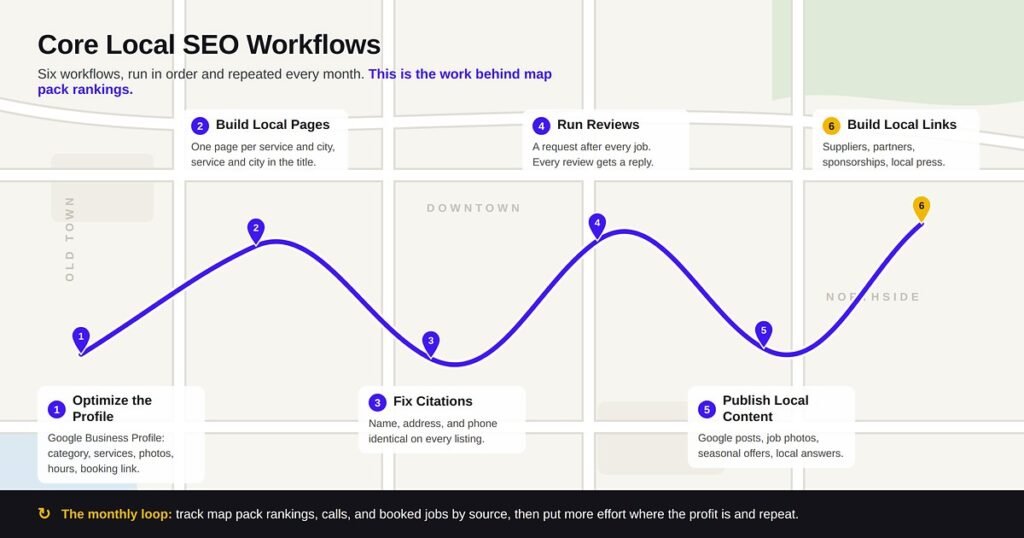
Local SEO helps your business attract people searching for roofing services in specific cities, towns, and neighborhoods.
For example, a contractor serving Tampa could target searches such as:
- Roofing company in Tampa, Florida
- Roof replacement in Brandon, Florida
- Emergency roof repair in Clearwater
- Commercial roofing contractor in Hillsborough County
Create dedicated service pages for your primary offerings and important service areas. Each page should explain the work you perform, the locations you cover, your process, and how customers can request an inspection.
Avoid publishing dozens of nearly identical city pages that simply replace one location name with another.
Pages should provide useful local information, such as common property types, relevant roofing services, project examples, and genuine service coverage.
Your local SEO work should include:
- Technical improvements that help search engines crawl and index your website.
- Service and location pages aligned with customer search intent.
- Accurate business listings and consistent contact information.
- Genuine customer reviews and relevant local links.
- Clear conversion paths, including phone calls and estimate requests.
A well-maintained website can attract leads without requiring you to pay for every click. However, organic rankings take time and are never guaranteed.
3. Build Landing Pages for Individual Roofing Services
A single homepage rarely addresses every roofing customer’s needs. A homeowner looking for a small leak repair should not have to navigate the same generic page as a commercial property manager planning a large roof replacement.
Create dedicated landing pages for your main services, such as:
- Residential roof replacement
- Roof repair and leak detection
- Storm damage roof inspections
- Commercial roofing installation
- Flat roof repair and maintenance
- Emergency roofing services
Each landing page should explain the service, identify the customers it suits, describe the process, and provide a clear next step.
For example, a commercial roofing page might discuss inspection scheduling, drainage problems, membrane damage, maintenance planning, and coordination with property managers.
Include project photographs, relevant qualifications, testimonials, and a short estimate request form. Ask only for information you need at the initial stage, such as name, contact details, property location, and project type.
A useful landing page gives prospects enough information to decide whether your company fits their requirements before they call.
4. Run Google Search Ads
Google Ads can help roofing contractors reach people actively searching for services. Unlike organic SEO, paid search can generate visibility shortly after a campaign becomes eligible to run.
Start with high-intent searches such as “roof replacement contractor,” “roof leak repair near me,” and “commercial roofing company.”
Separate campaigns or ad groups by service where budget permits. This makes it easier to match ad copy and landing pages to the prospect’s needs.
For instance, an advertisement for emergency roof repairs should lead to a page focused on repair services, not a generic page promoting every roofing service.
Use location targeting carefully. Exclude areas your crews cannot serve and review search terms regularly to identify irrelevant clicks.
Track phone calls, completed forms, qualified inspections, and signed jobs. A campaign that produces inexpensive inquiries but few estimates may be less valuable than one with a higher cost per lead and better project quality.
Before increasing your budget, confirm that calls are being answered and leads receive timely follow-up.
5. Test Google Local Services Ads
Google Local Services Ads can provide another way for eligible roofing businesses to appear prominently in local search results.
Availability, eligibility requirements, verification procedures, and billing arrangements depend on the market and current Google policies. Check the official Local Services Ads documentation before building your budget around this channel.
If the product is available for your business, complete the required verification and keep your business information accurate.
Evaluate the channel based on qualified inquiries and booked work, rather than visibility alone. Review which service types, locations, and lead categories produce the strongest results.
Local Services Ads can be useful when you need additional opportunities quickly. They should complement a broader strategy rather than replace your website, local reputation, or organic search presence.
6. Build a Referral Program
Past customers, suppliers, real estate professionals, and other local businesses can introduce you to prospects who already have some reason to trust your company.
The simplest way to generate referrals is to build a repeatable process around customer satisfaction.
After completing a roofing project:
- Confirm that the customer is satisfied with the completed work.
- Send the final documentation and explain any relevant warranties.
- Ask for an honest review.
- Invite the customer to recommend your company if someone they know needs roofing work.
- Follow up later when a relevant maintenance or inspection opportunity arises.
You can also develop relationships with property managers, real estate agents, home inspectors, builders, and restoration companies.
For commercial roofing, relationships with facility managers, commercial real estate brokers, and property management firms can be especially relevant.
Any referral fee or reward should be transparent and comply with applicable laws, licensing rules, and platform policies.
Referrals may not produce a predictable volume every week, but they can become a valuable source of opportunities when your company consistently delivers good work.
7. Use Neighborhood Marketing After Completing a Roof
When your team finishes a roof replacement, nearby homeowners have a visible example of your work.
Use the project to build local awareness, provided you have the necessary permissions and follow local solicitation rules.
You can distribute a professional door hanger, send a permitted neighborhood mailing, or share project photographs with local community groups.
Your message should be specific. Rather than saying that you offer the best roofing services in town, explain that your company recently completed a roof replacement in the neighborhood and offers inspections or estimates to nearby property owners.
A useful neighborhood campaign can include:
- A photograph of the completed project.
- A brief description of the work performed.
- Your service area and contact information.
- A clear invitation to request an inspection or estimate.
Do not imply that neighboring properties have storm damage without inspecting them. If a storm has affected the area, explain what warning signs homeowners can look for and recommend a professional inspection where appropriate.
This approach connects your marketing to real work rather than relying entirely on generic advertisements.
8. Create Useful Roofing Content
Content marketing can attract people who are researching roofing problems before they are ready to hire a contractor.
Publish articles that answer questions your sales team hears regularly, including:
- How to Tell If a Roof Needs Repair or Replacement
- What to Expect During a Roof Inspection
- Common Causes of Roof Leaks
- How to Prepare for a Roof Replacement
- Questions to Ask Before Hiring a Roofing Contractor
- How Commercial Roof Maintenance Helps Identify Problems
A useful article explains the issue, describes the available options, and identifies when a professional inspection may be appropriate.
Include relevant internal links to your service pages. Someone reading about roof leaks should be able to reach your roof repair page without searching through the entire website.
You can also repurpose content into short videos, email newsletters, social posts, and downloadable inspection checklists.
Avoid publishing articles solely to target keywords. Content is more likely to support your business when it addresses a genuine customer concern and provides a clear path to your services.
9. Use Meta (Instagram+Facebook) Ads
Social advertising can help roofing businesses reach homeowners in selected service areas, particularly when promoting inspections, seasonal maintenance, completed projects, or storm-related services.
Unlike search advertising, social campaigns often reach people who were not actively looking for a roofer when they saw the advertisement. Your creative and offer therefore need to establish relevance quickly.
Use real project photographs, short installation videos, customer testimonials shared with permission, and clear explanations of the service.
For example, a campaign might promote a roof inspection for homeowners who have noticed missing shingles or signs of water intrusion.
You can test different creative formats and calls to action, but measure qualified leads and booked inspections rather than likes or video views.
Retargeting may also help you reconnect with eligible website visitors who have not submitted an inquiry. Configure tracking and advertising audiences in accordance with applicable privacy requirements.
Social advertising is most useful when your company has a clear offer, a relevant audience, and a process for following up with inquiries.
10. Generate Commercial Roofing Leads Through Direct Prospecting
Commercial roofing leads often require a different approach from residential leads. The buying process may involve property managers, facility directors, building owners, procurement teams, and maintenance contractors.
A practical starting point is to build a list of commercial properties within your service area that fit your capabilities.
Potential prospects include:
- Warehouses and distribution centers.
- Retail centers and office buildings.
- Industrial facilities.
- Apartment complexes and multifamily properties.
- Schools and other institutional buildings.
- Commercial property management firms.
Prioritize prospects by property type, location, approximate building size, and the roofing systems your team can service.
Then research the appropriate business contact. A facility manager may oversee maintenance, while a property manager or asset manager may influence larger replacement projects.
Your outreach should focus on a relevant business need. For instance, offer a planned roof condition assessment, maintenance discussion, or review of recurring leak issues.
Avoid sending the same generic message to every contact. A short email that explains your commercial roofing capabilities and why the service may be relevant is more useful than a broad sales pitch.
Track outreach attempts, responses, meetings, inspections, proposals, and contracts in a CRM.
Commercial prospecting generally requires more follow-up than an urgent residential repair inquiry. Measure progress by qualified conversations and opportunities, not just the number of contacts collected.
11. Develop Partnerships With Related Businesses
Roofing contractors frequently work alongside other professionals who encounter property owners with roofing needs.
Potential partners include general contractors, gutter installers, solar installation companies, insurance restoration businesses, real estate agents, and property management firms.
Start by identifying businesses that serve the same customers without directly competing with your core roofing services.
Explain the types of projects you handle, your service area, and the situations in which a referral would make sense. Agree on a straightforward process for introductions and customer communication.
For example, a solar installer may discover roof condition issues during a project. A property manager may need a roofer to inspect recurring leaks before approving other building work.
Partnerships work best when you respond promptly, communicate clearly, and protect the partner’s reputation by delivering dependable service.
Do not assume every partner will produce leads immediately. Develop a small number of relevant relationships and evaluate their quality over time.
12. Buy Roofing Leads From Third Party Providers
Buying roofing leads can help contractors generate inquiries without waiting for organic search visibility or referrals to grow.
However, purchased leads vary considerably in quality. Some providers send the same inquiry to several contractors, while others offer exclusive leads or connect businesses with people making live calls.
Before purchasing, understand exactly what you are paying for. Ask the provider questions:
- Is the lead exclusive or shared?
- What information does the homeowner submit?
- How are service areas and project types matched?
- How are duplicate, invalid, or unresponsive leads handled?
- Is there a minimum spend or contract term?
- Can you track the lead through to a booked job?
- What evidence of consent is available for marketing calls or texts?
Do not compare providers only by advertised cost per lead. A less expensive inquiry may have little value if the homeowner is outside your service area or has already contacted several competitors.
Start with a controlled test, set a spending limit, and review actual performance before committing to a larger package.
13. Improve Your Lead Follow-Up Process
Generating a roofing lead does not guarantee that the prospect will book an inspection.
A clear follow-up process helps your team respond consistently and prevents inquiries from getting lost between calls, emails, and estimate appointments.
When a new lead arrives, capture the source, requested service, location, and preferred contact method. Respond promptly during business hours and provide a clear next step.
Your first conversation should establish:
- What roofing problem or project the prospect needs help with.
- Where the property is located.
- Whether the work falls within your service area and capabilities.
- How urgent the issue is.
- When the prospect is available for an inspection.
If the prospect is qualified, arrange the next step and confirm the appointment.
If the person is not ready to proceed, record the outcome and schedule a reasonable follow-up where appropriate.
Use a CRM or simple lead tracking system to record every inquiry, assigned salesperson, appointment, estimate, and outcome.
Review the pipeline regularly to identify missed calls, delayed responses, and estimates that need follow-up. The objective is to make every legitimate inquiry easy to track and act on.
14. Use AI Tools for Roofing Lead Generation
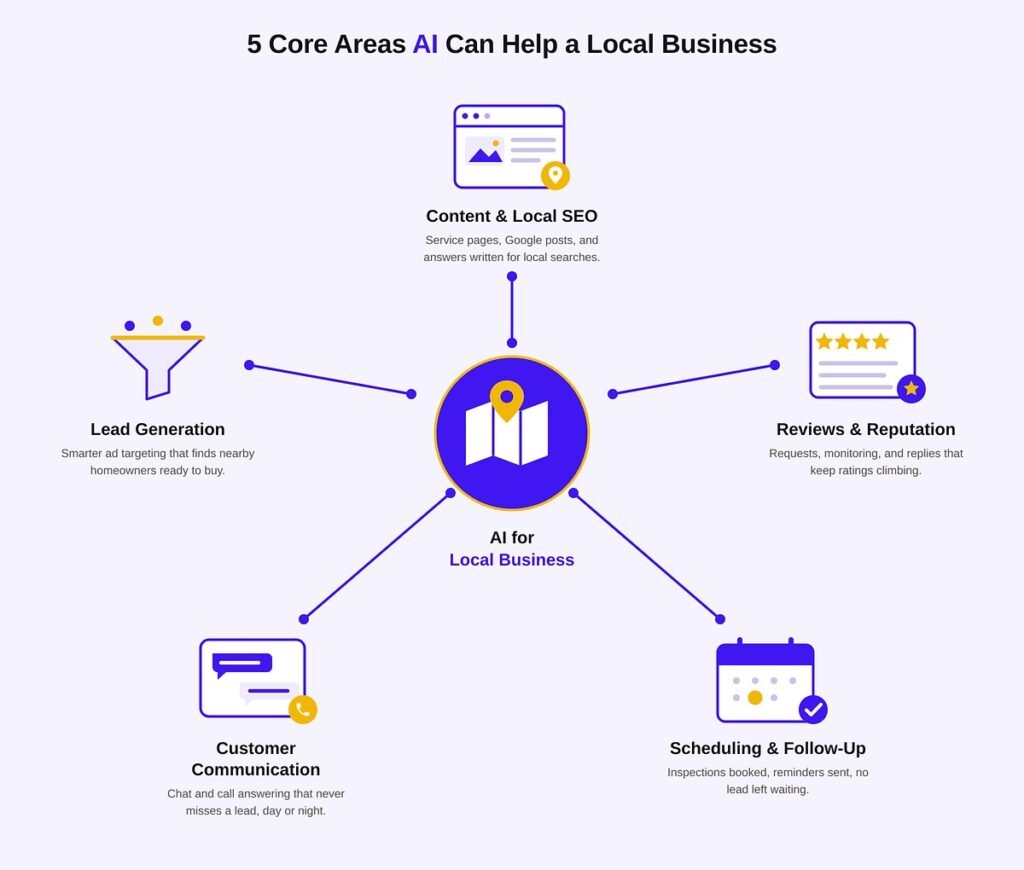
AI tools can help roofing companies and marketing teams complete research, content production, and lead management tasks more efficiently. They are most useful when applied to a clearly defined workflow.
AI for prospect research:
Use AI-assisted research to organize public information about commercial properties, property management companies, and potential business accounts. Verify the underlying information before adding prospects to your sales pipeline.
AI for content creation:
Generate initial outlines for roofing service pages, educational articles, email campaigns, and frequently asked questions. Have a knowledgeable editor check technical claims and adapt the content to your actual services.
AI for lead qualification:
Where your CRM supports it, use automated rules or AI-assisted categorization to group inquiries by service type, urgency, service area, and project requirements. Keep a human involved when information is unclear.
AI for follow-up:
Draft personalized email responses, summarize previous interactions, and prepare reminders for sales representatives. Review automated messages to ensure they are accurate and appropriate.
AI for marketing analysis:
Use reporting tools to compare lead sources, campaign spending, booked inspections, and closed jobs. The value comes from identifying which channels generate worthwhile opportunities, not simply producing more reports.
15. Use Email Marketing to Generate Repeat and Referral Business
A roofing company does not need to depend entirely on new prospects. Previous customers may need repairs, maintenance, inspections, or future replacement work.
Build an appropriate customer database and organize contacts according to service history, property type, and communication preferences.
Useful email campaigns include:
- Seasonal roof maintenance reminders.
- Follow-ups after completed inspections.
- Educational messages about common roofing problems.
- Maintenance planning for commercial property managers.
- Requests for honest reviews and referrals.
- Updates about services relevant to existing customers.
Keep messages relevant and useful. A homeowner who recently replaced a roof does not need repeated replacement promotions, but may appreciate maintenance information and warranty documentation.
For commercial customers, a scheduled maintenance reminder or inspection follow-up may help keep your company in consideration when a problem develops.
6 Best Roofing Lead Generation Companies to Consider
Roofing companies can generate leads through two main approaches: buying inquiries from third-party providers or building their own lead generation channels through local SEO, content marketing, and inbound marketing.
The right choice depends on your budget, service area, project types, and whether you want immediate lead opportunities or a long-term source of organic inquiries.
Here are six companies to consider, including a local SEO and inbound lead generation option for roofing contractors that want to build their own pipeline.
1. Leads Crawler: Best for Local SEO and Inbound Roofing Leads
Leads Crawler helps local service businesses build a stronger online presence and attract potential customers through local SEO, search engine optimization, content marketing, and lead generation strategies.
For roofing companies, this approach focuses on reaching homeowners and commercial property managers when they search for services such as roof replacement, roof repair, storm damage inspections, and commercial roofing.
Rather than relying entirely on purchased leads, roofing contractors can build dedicated service pages, improve their Google Business Profile, publish useful roofing content, and target relevant local searches in their service areas.
The objective is to create a repeatable source of inbound inquiries while building long-term visibility for the roofing business.
Key benefits:
Local search visibility: Improve your presence for relevant roofing searches in your target service areas.
Inbound lead generation: Attract prospects who are actively researching roofing services.
Long-term growth: Build organic traffic and local visibility instead of depending exclusively on paid lead providers.
Website conversion improvements: Make it easier for potential customers to request inspections, estimates, and consultations.
Best for: Roofing contractors that want to attract local customers through organic search, local SEO, and inbound lead generation.
Why choose Leads Crawler?
Leads Crawler is worth considering if you want to build your own roofing lead generation channel rather than depend solely on third-party marketplaces.
Local SEO and inbound marketing can help establish your business as a recognizable option in the communities you serve.
These channels require time, consistent execution, and ongoing measurement. Rankings and lead volume are not guaranteed, but a well-managed strategy can support long-term customer acquisition.
2. Angi: Best for Home Services Marketplace Leads
Angi connects homeowners with home service professionals across multiple categories. Roofing contractors can evaluate its lead opportunities when they want to reach consumers looking for residential roofing services.
Before signing up, review the current pricing, lead distribution rules, and terms. Confirm whether inquiries are shared with other contractors and how unsuitable leads are handled.
Website: https://www.angi.com/
3. Thumbtack: Best for Testing Local Project Demand
Thumbtack connects consumers with service professionals in a range of home improvement categories. It may be useful for roofing contractors testing demand in specific locations.
Evaluate the current professional pricing, customer contact process, and project targeting options before committing a substantial budget.
Website: https://www.thumbtack.com/
4. Modernize: Best for Residential Home Improvement Leads
Modernize focuses on home improvement marketing and lead generation. Roofing contractors can evaluate its offerings if they primarily handle residential roofing and replacement projects.
Ask about lead qualification, geographic availability, exclusivity, and pricing before choosing a program.
Website: https://modernize.com/
5. Service Direct: Best for Trackable Inbound Calls and Leads
Service Direct offers pay-per-lead marketing for local service businesses, including roofing-related opportunities.
It may suit contractors who want to measure inbound calls and form submissions against booked inspections and completed jobs. Confirm the current pricing model and lead qualification rules directly with the provider.
Website: https://servicedirect.com/
6. Networx: Best for Additional Home Improvement Opportunities
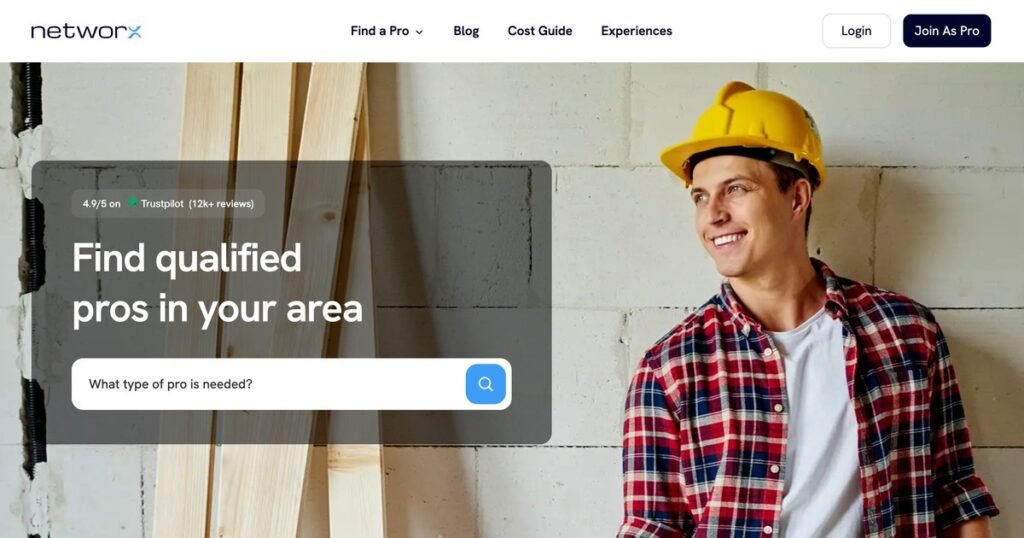
Networx operates in the home improvement lead generation market and connects consumers seeking projects with service providers.
Roofing contractors can assess its offerings against their service areas, project types, and available sales capacity.
Before purchasing, confirm how leads are distributed and what protections apply to invalid or unsuitable inquiries.
Website: https://www.networx.com/
Which Roofing Lead Generation Company Should You Choose?
Choose Leads Crawler if your priority is building a long-term source of roofing leads through local SEO, organic search visibility, content marketing, and inbound lead generation.
Consider third-party providers if you want to test additional inquiry sources without waiting for organic search performance to develop. Compare their costs against qualified inspections, signed contracts, and customer acquisition costs rather than lead volume alone.
How to Choose the Right Roofing Lead Provider
Compare each provider against the same criteria before spending money.
First, establish the maximum amount you can afford to spend to acquire a profitable roofing customer. Then test a limited number of leads and track the results from initial contact to signed contract.
Do not judge a provider by lead volume alone. If a source generates many inquiries but few qualified inspections, its low headline price may be misleading.
How Much Do Roofing Leads Cost?
Roofing lead costs vary by location, project type, advertising channel, exclusivity, and the quality of the inquiry. There is no single price that accurately represents every roofing lead.
The following table explains the main pricing models without presenting unsupported industry averages.
| Lead source | Typical cost model | Main consideration |
|---|---|---|
| Referrals | No direct fee per inquiry in many cases | Requires a strong customer experience and referral process |
| Local SEO | Website and marketing investment over time | Results take time and are not guaranteed |
| Google Search Ads | Pay per click | Cost depends on competition and campaign performance |
| Local Services Ads | Lead-based billing where available | Eligibility and billing depend on current platform rules |
| Social advertising | Pay per click or campaign delivery | Lead intent varies by offer and audience |
| Lead marketplaces | Per lead or other provider-specific pricing | Leads may be shared with competitors |
| Commercial prospecting | Staff time and research costs | Sales cycles can be longer |
When comparing costs, calculate cost per qualified lead, cost per booked inspection, and cost per acquired customer.
For example, imagine two lead sources produce different outcomes.
Provider A delivers 20 leads for $100 each, costing $2,000. Two customers sign contracts.
Provider B delivers 10 leads for $150 each, costing $1,500. Three customers sign contracts.
Provider A costs $1,000 per acquired customer. Provider B costs $500 per acquired customer.
These figures are hypothetical, but they illustrate why a higher price per lead does not necessarily mean a worse investment.
How to Measure Roofing Lead Generation Performance?
A roofing marketing campaign should be evaluated by the business results it produces, not just its activity.
Track these metrics by lead source:
Cost per lead: Total marketing spend divided by the number of leads received.
Qualified lead rate: The percentage of inquiries that match your service area, project type, and customer requirements.
Appointment rate: The percentage of leads that result in scheduled inspections or estimates.
Close rate: The percentage of qualified opportunities that become paying customers.
Customer acquisition cost: The marketing and sales costs associated with acquiring a new customer, calculated using a consistent accounting method.
Revenue and gross profit by source: The revenue and, where available, gross profit associated with jobs generated by each channel.
A source producing fewer leads may outperform one producing more if those leads lead to better projects and stronger margins.
Give every inquiry a source label, whether it came from Google, a referral, a purchased lead, a paid social campaign, or commercial outreach. Review the results regularly and move budget toward channels that generate profitable work.
Frequently Asked Questions
1. How do you get commercial roofing leads?
Build a list of commercial properties and property management firms within your service area. Identify relevant decision makers, such as facility managers and property managers, then offer services that match their needs, including inspections, maintenance, repairs, and replacement planning.
2. How can roofing companies generate leads without door knocking?
Focus on inbound and relationship-based channels such as local SEO, Google Business Profile optimization, paid search, referrals, useful website content, social advertising, email marketing, and commercial prospecting.
3. How much do roofing leads cost?
Roofing lead costs vary by channel, location, project value, exclusivity, and lead quality. Advertising clicks, shared marketplace inquiries, exclusive leads, and live calls use different pricing models.
4. How can you increase conversions on roofing leads?
Respond promptly, confirm the customer’s project requirements, check that the property is within your service area, and offer a clear next step. Track every inquiry through the inspection, estimate, and contract stages.
5. What is the best way to get roofing leads?
For many local roofing businesses, a combination of local SEO, a well-designed service website, customer referrals, and paid search provides a sensible starting point.
Conclusion
Getting roofing leads consistently requires more than one advertising campaign. A dependable pipeline combines local visibility, a credible reputation, targeted outreach, and a clear process for handling inquiries.
Start with the channels that fit your current resources. Improve your Google Business Profile, build focused service pages, ask satisfied customers for honest reviews, and track every lead through to the final sale.
If you want to identify gaps in your roofing lead generation strategy, we can help you assess opportunities across local SEO, lead generation, and digital marketing. Book a growth call to discuss a practical plan for your business.