

The search for senior living rarely starts with a phone call to a sales office. It starts on a phone screen, late at night, right after a fall or a hospital stay.
Someone turning 65 today has almost a 70% chance of needing long-term care in their remaining years, the Administration for Community Living reports. Families feel it.
This article explains the best lead generation strategies for senior living communities, including local SEO, and the costs involved.
What Is Lead Generation for Senior Living?
Lead generation for senior living is the work of attracting families who are actively looking for care, then guiding them toward a tour, a call, or a consultation.
Inbound lead generation earns that attention through search visibility, helpful content, and honest reviews, instead of buying names or chasing cold lists of strangers.
For a community, the prize is a lead it owns. The family found you, chose you, and can return to your site at any point in a decision that often runs for months.
Done well, inbound lead generation brings inquiries from local search, content, and reviews, and every inquiry belongs only to the community.
Why Lead Generation for Senior Living Facilities Starts With Local Search
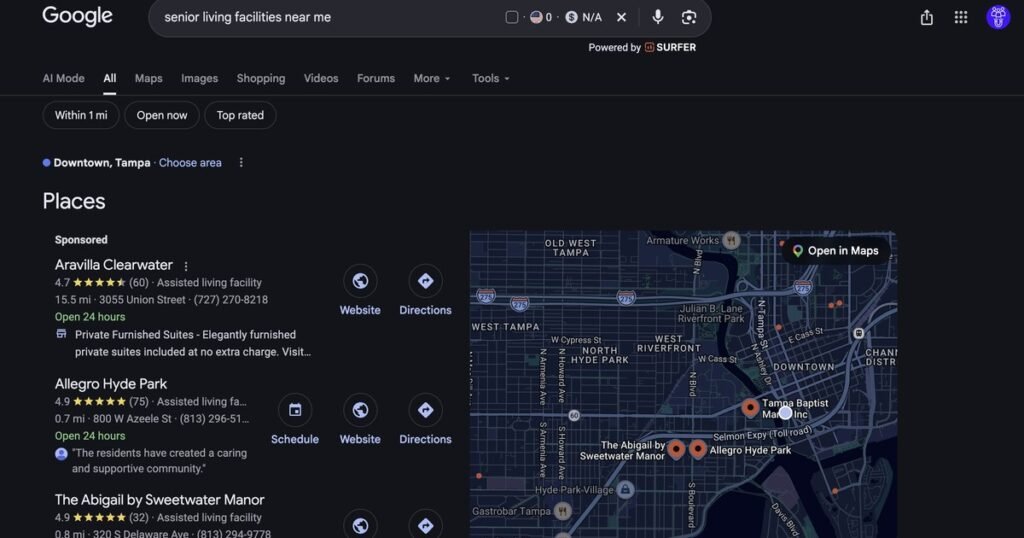
Nobody shops for senior living the way they shop for shoes. They choose care close to home, usually within a short drive of the adult child who visits weekly.
A daughter in Ohio does not tour communities in Florida for her father. She searches for care near her own street, or near the hospital that just discharged him.
That is why senior living lead generation is a local contest before it is anything else. The searches that matter sound like assisted living near me, memory care in a named suburb, or the name of a community a neighbor mentioned.
Google answers those searches with a map pack and three local listings before any regular result. A community that is missing from that map is missing from the decision, no matter how warm its lobby feels on a tour.
Urgency shapes these searches too. Many begin within hours of a trigger event, a fall, a hospital discharge, a diagnosis, or the night a spouse admits she cannot manage alone anymore. Families in that moment do not browse ten websites.
They call the communities that appear first, read a handful of reviews, and book tours with whoever answers clearly and quickly.
Demand is not the problem. The National Investment Center reported senior housing occupancy at 89.1% at the end of 2025, the eighteenth straight quarter of growth, with new construction below 1%.
Buildings are filling, and the open units go to the communities families find first. Visibility decides who gets the tour, and the tour decides who gets the move-in.
Two People Sit Behind Almost Every Search
Almost every inquiry has two decision makers, the senior and an adult child, and they search with different fears. The adult child, often a daughter in her fifties, does most of the research on her phone.
She compares prices, reads reviews, and worries about safety and guilt. The senior worries about dignity, daily life, and losing the home they know.
Do not assume the senior is offline. Pew Research Center reports that 90% of adults aged 65 and older use the internet. Grandparents read the same reviews their children read.
Content that speaks only to the adult child misses half the room, and content written for both- cost answers for the daughter and detail for her parent- holds attention longer.
What Local Search Visibility Actually Includes
Local visibility is a set of habits that keep a community present every time a family searches nearby.
- A complete Google Business Profile for each community, with the right care categories, current photos, and accurate hours.
- A steady flow of Google reviews, requested at natural moments and answered, including the hard ones.
- A page on the website for each community and each care level, written for the families searching there.
What Happens When a Senior Living Community Skips This
Communities that cover those basics show up again and again in local results. The rest hand their families to competitors and to referral sites that charge for the introduction.
7 Best Strategies for Senior Living Facilities to Generate Inbound Leads

Operators asking how to generate leads for senior living facilities get handed a list of channels. Channels are not the hard part. The hard part is building an owned system where each piece feeds the next, so inquiries keep arriving whether or not a referral site sends anyone.
1. Build Local SEO Around Each Community and Care Level
Every community needs its own page, and every care level needs one too. A family searching for memory care in a suburb should land on a page about memory care in that suburb, not a homepage.
Pages should cover care offered, pricing guidance, daily life, staff, and the neighborhoods the community serves. This is the core of local lead generation for a senior living operator, and where our local SEO services start.
2. Answer the Questions Families Ask at Midnight
Families research for weeks before they call. They search for signs it is time for assisted living, what memory care costs, how to talk to a parent about moving, and what a tour should cover.
Articles and guides that answer those questions honestly earn the visit long before a competitor is considered.
Assisted living lead generation often begins with a worried search at midnight, and the community that answered it owns the relationship from that night on.
3. Treat Reviews as a Lead Channel, Not a Report Card
Reviews sit at the point of decision. A community with forty recent reviews and thoughtful replies will take tours from a community with nine old ones, even when the buildings are equals.
Ask after a good tour, a smooth move-in, or a kind word at the front desk. Reply to every review, especially the critical ones, in a calm voice that shows how the home treats people. Stars bring the click. Replies bring the tour.
4. Build Landing Pages for One Care Level at a Time
A page trying to sell independent living, assisted living, and memory care at once sells none of them well.
Each care level deserves its own page with its own photos, pricing guidance, and tour booking path. Families land, see their exact situation described, and act.
5. Offer One Genuinely Helpful Lead Magnet
Many families research months before they are ready to tour. A cost planning worksheet, a tour checklist, or a care needs assessment gives them a reason to share an email address.
The magnet has to help on its own, not tease. A checklist a daughter prints and carries into three competing tours keeps your community name in her hand the whole time.
6. Support Search With Paid Ads Where Intent Is Highest
Paid search has a place, pointed at the searches that signal a family is ready now, such as care in a named city or a community name plus reviews.
Retargeting keeps your community in front of families who visited your site and left to keep researching. Paid ads rent attention while organic rankings grow, and they should shrink as a share of inquiries over time, not grow.
7. Answer Every Inquiry Within the Hour
An inbound system fails at the front desk more often than at Google. A family that sends a form at 9 in the evening and hears back the next afternoon has already booked two other tours.
Route every inquiry into one pipeline and reply within the hour during waking hours. Then keep following up for months.
Senior living decisions move slowly, and the community that stays in contact wins move-ins that faster starters gave up on.
Lead Generation for Senior Living Cost: Owned Leads vs Rented Leads
The honest answer to lead generation for senior living cost is that it depends on the model you choose. A community can rent leads from referral sites, buy clicks from Google, or build an owned pipeline on its own website.
| Channel | How the lead arrives | Who owns the lead | How you pay |
| Local SEO and your website | A family finds your community in local search and contacts you directly | You | A monthly program cost that falls per lead as rankings and reviews grow |
| Paid search ads | A family clicks your ad on a high-intent search | You | Per click, and the flow stops the day the budget stops |
| Third-party referral sites | A site sends a family that is comparing several communities | The referral site | A fee charged when the referred resident moves in |
| Direct mail and events | A household answers a mailer or attends an open house | You | Per campaign or per event |
The referral route looks free until a resident moves in, and then the fee arrives for a family that was also shown to your competitors.
Nothing about that lead is yours. You cannot write to the families who chose someone else, and the next family costs the same fee again.
An owned pipeline works the other way. The first months carry the cost of pages, profiles, and reviews. After that, each new inquiry costs less than the one before, because the rankings and reputation doing the work are already yours.
When operators ask for the most cost-effective way to generate leads for senior living facilities, this compounding effect is the answer, not a cheaper list.
How a Community Knows the System Is Working
Track four numbers for each community: inquiries, tours booked, move-ins, and cost per move-in. A rise in inquiries with flat tours points at the follow-up, not the marketing.
Strong tours with weak move-ins point at the tour itself. Cost per move-in is the number that settles arguments between channels, because it counts what a filled unit actually cost.
Reading the Monthly Pattern
Review the numbers monthly and tie every inquiry to its source in your records. Within two quarters, the pattern is plain: which pages bring tours, which referral invoices were worth paying, and where the next hour of work should go.
Senior living lead generation gets easier to fund when nobody has to guess what it produced.
Frequently Asked Questions
What is lead generation for senior living?
Lead generation for senior living means attracting families who are looking for care and turning that interest into tours and move-ins. It runs on local search, content, reviews, and follow-up.
What is the most cost-effective way to generate leads for senior living facilities?
An owned pipeline built on local SEO is the most cost-effective route, since leads cost less as rankings and reviews grow. Referral sites charge at move-in, and leads stay shared.
Does SEO work for senior living facilities?
Yes. Families search Google for care near them, often after a hospital stay or a fall. A facility ranking in the map results earns the call before competitors are seen.
How long does it take for local SEO to bring in senior living leads?
Most communities see movement in local rankings within three to six months, with inquiries building from there. Paid ads fill the gap meanwhile.
Wrap Up
Families will keep starting their search for care on Google. The communities that appear with clear answers, strong reviews, and an easy path to a tour win the move-ins.
An owned inbound pipeline takes months to build and years to wear out. Unlike rented leads, it keeps producing long after the work is done, at a lower cost per family.
If your community is ready to grow its own pipeline, book a free growth call with us, and we will map the local search work your market needs first, together.