

HVAC lead generation is the process of attracting and converting homeowners and businesses that need heating, cooling, ventilation, repair, maintenance, or replacement services.
For HVAC contractors, lead generation has to match the urgency of the job. A broken AC in July needs a different acquisition path than a commercial building planning an HVAC replacement.
The opportunity is substantial because heating and air conditioning remain major household energy uses. The U.S. Energy Information Administration reported that HVAC systems accounted for 52% of household energy consumption in 2020.
What Is HVAC Lead Generation?
HVAC lead generation is the process of creating demand for an HVAC company and turning that demand into calls, quote requests, appointments, or other sales opportunities.
The strongest HVAC lead generation strategy usually combines several channels instead of depending on one source.
- Local SEO and Google Business Profile
- Google Ads and pay-per-call HVAC leads
- Service-specific landing pages
- Reviews, referrals, and local content
- Social media and remarketing
- Commercial prospecting and outbound outreach
The right mix depends on the contractor’s service area, job types, average ticket, competition, and sales capacity.
Why Is HVAC Lead Generation Important?
HVAC customers often search when they have a specific problem or an upcoming project. That creates valuable search intent around services such as AC repair, furnace replacement, heat pump installation, ductwork, maintenance, and commercial HVAC.
A contractor that consistently appears when those searches happen has more opportunities to generate qualified inquiries without relying entirely on referrals or seasonal advertising.
Lead generation also gives HVAC companies greater control over their sales pipeline. Instead of waiting for customers to call, contractors can build acquisition channels around specific services, locations, and customer needs.
7 Practical HVAC Lead Generation Strategies
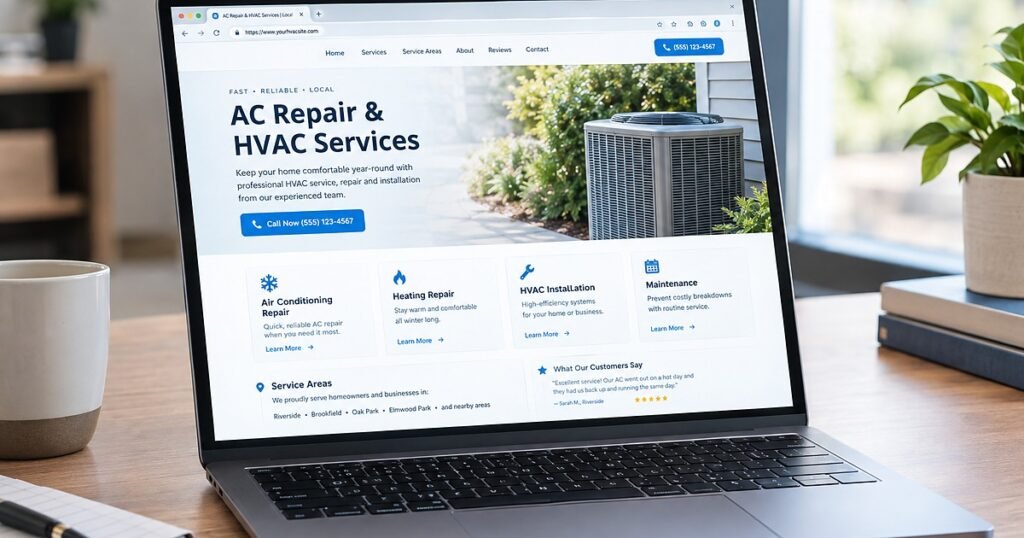
1. Build Local SEO Around HVAC Services
Local SEO should connect your HVAC company with the services and locations you actually serve. Create dedicated pages for important services such as:
- AC repair
- Air conditioner installation
- Furnace repair
- Furnace replacement
- Heat pump installation
- HVAC maintenance
- Duct cleaning and repair
- Indoor air quality
- Commercial HVAC services
Location relevance matters too. An HVAC company serving Tampa, Florida, for example, may need different service content from a contractor operating in Denver or Minneapolis.
Google says local results are primarily influenced by relevance, distance, and prominence. Complete and accurate Business Profile information helps Google understand the business and match it with relevant searches.
That makes service pages, location pages, reviews, citations, and an accurate Google Business Profile important parts of an HVAC lead generation system.
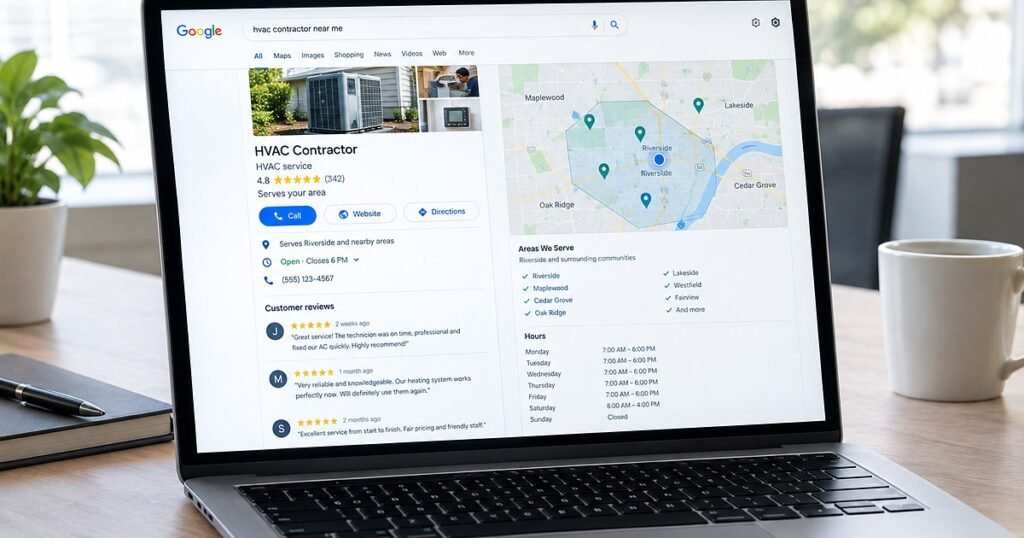
2. Turn Your Google Business Profile Into a Lead Channel
A Google Business Profile can generate calls and website visits directly from local search and Google Maps.
For service-area HVAC businesses, the profile should accurately represent the areas the company serves. Google lets you specify service areas using cities, postal codes, or other defined areas rather than a simple radius.
Keep the profile aligned with the actual business:
- Select the appropriate primary and secondary categories.
- List genuine HVAC services.
- Maintain accurate phone, website, and business information.
- Add high-quality project and team photos.
- Request legitimate customer reviews.
- Respond to customer reviews.
- Keep service areas current.
Do not create fake locations to target cities where the HVAC company has no actual presence. Local visibility depends on accurate business representation.
3. Use Google Ads for High-Intent HVAC Leads
Paid search can put an HVAC company in front of customers who are actively looking for a service.
Search campaigns can target terms associated with immediate needs, such as “AC repair near me,” “emergency furnace repair,” or “commercial HVAC contractor.”
Google’s Local Services advertising model is particularly relevant to local contractors because businesses are charged for valid leads rather than standard clicks. Lead prices vary by location, job type, lead type, and bidding settings.
For HVAC contractors, the important metric is not simply cost per lead. Track:
- Lead cost
- Contact rate
- Appointment rate
- Booked-job rate
- Customer acquisition cost
- Revenue by lead source
A $70 lead that produces no appointment is not automatically cheaper than a $150 lead that consistently produces profitable jobs.
4. Create Landing Pages for Residential HVAC Leads
Residential HVAC leads usually have a specific problem or buying trigger.
A landing page should therefore answer the customer’s immediate questions without forcing them to navigate the entire website.
A strong AC repair landing page can include:
- Service area
- Common AC problems
- Repair services offered
- Emergency availability, if applicable
- Reviews
- Licensing or certifications where relevant
- Clear phone and quote options
- Frequently asked questions
Separate pages can target installation, replacement, maintenance, heating, cooling, and indoor air quality.
The page should also make the next step obvious. A visitor looking for emergency AC repair should not have to search for a phone number.
5. Build a Separate Strategy for Commercial HVAC Leads
Commercial HVAC leads often involve different decision-makers, longer sales cycles, and larger projects.
Commercial prospects may include property managers, facility managers, general contractors, building owners, restaurants, warehouses, retail locations, and office buildings.
Commercial HVAC lead generation can combine:
- Local SEO
- Industry-specific service pages
- LinkedIn prospecting
- Email outreach
- Building and property research
- Referral partnerships
- Local business networking
- Content targeting facility managers and property owners
The messaging should reflect the commercial buyer’s concerns, such as maintenance schedules, equipment replacement, response times, operating costs, compliance, and business disruption.
6. Consider Pay Per Call HVAC Leads
Pay-per-call HVAC leads charge based on qualifying phone calls rather than website traffic or impressions.
This model can work well for services where customers prefer speaking with a contractor, particularly urgent repair and replacement inquiries.
Before purchasing pay-per-call leads, ask:
- Is the call exclusive or shared?
- What makes a call billable?
- Is there a minimum call duration?
- Are calls filtered by location?
- Are existing customers excluded?
- Can irrelevant calls be disputed?
- Are recordings available for quality review?
Do not compare vendors using advertised lead prices alone. Compare the cost of a booked and profitable job.
7. Use AI to Improve HVAC Lead Generation
AI can support HVAC lead generation without replacing the fundamentals of local marketing. Practical uses include:
- Researching service and customer questions.
- Grouping keywords by service and location.
- Creating initial content briefs.
- Identifying gaps across existing service pages.
- Summarizing lead conversations for sales follow-up.
- Drafting personalized outreach for commercial prospects.
- Analyzing lead sources and customer inquiries.
The human review remains important. HVAC content needs accurate service terminology, realistic customer scenarios, correct service areas, and technically responsible claims.
AI should reduce repetitive research and analysis rather than generate generic pages at scale.
HVAC Lead Generation Channels Compared
Different channels produce different types of opportunities. The best mix depends on the contractor’s market and sales process.
| Channel | Best use | Main advantage | Main consideration |
| Local SEO | Ongoing residential and commercial demand | Builds organic visibility | Takes time to establish |
| Google Business Profile | Local service searches | Direct local discovery | Requires accurate information and reviews |
| Google Ads | Immediate search demand | Fast access to high-intent searches | Requires ongoing ad spend |
| Local Services Ads | Calls and local service inquiries | Pay-per-lead model | Lead costs vary by market and service |
| Pay per call | Urgent HVAC services | Direct phone opportunities | Lead quality and exclusivity must be checked |
| Social media | Awareness and remarketing | Useful for staying visible | Often lower purchase intent than search |
| Commercial outreach | B2B HVAC opportunities | Can target specific accounts | Requires prospecting and follow-up |
The most reliable approach is usually a combination of channels rather than treating one source as the entire marketing strategy.
How Much Do HVAC Leads Cost?
There is no single reliable price for an HVAC lead.
Lead cost changes based on the service, location, competition, lead source, exclusivity, customer intent, and billing model. Google also states that Local Services lead prices vary by location, job type, lead type, and bidding mode.
Instead of asking only “How much do HVAC leads cost?”, calculate the economics of the complete sales process.
For example:
Cost per booked job = total lead spend ÷ booked jobs
Then compare that figure with the average gross profit generated by those jobs.
A contractor buying residential HVAC leads should also distinguish between repair, maintenance, replacement, and installation opportunities. Their commercial value can differ substantially.
How to Choose HVAC Lead Generation Services
An HVAC lead generation company should be evaluated on more than the number of leads it promises. Look for a provider that can explain:
- Where the leads originate.
- Whether leads are exclusive or shared.
- How leads are qualified.
- Which locations are covered.
- Which HVAC services are targeted.
- How duplicate or irrelevant leads are handled.
- Which performance metrics are reported.
- How the campaign connects with your sales process.
5 Best HVAC Lead Generation Companies
For contractors comparing providers, the right choice depends on the type of lead acquisition they need.
1. leads Crawler
Leads Crawler is a strong starting point for HVAC companies looking for an inbound lead generation partner rather than a single advertising channel. Our services can combine lead generation, local SEO, and content marketing.
That model is particularly relevant when an HVAC company wants to build owned acquisition channels instead of depending entirely on purchased leads.
The key is to match the provider’s capabilities with the contractor’s actual requirements. A business looking only for immediate phone calls may need a different service than one trying to build long-term organic visibility.
2. WebFX
WebFX is a full-service lead generation and digital marketing agency. It offers both inbound and outbound lead gen services for HVAC businesses. They can be a great choice if you are aiming for holistic or multi-channel marketing.
With wide service coverage, quality can become an issue sometimes. They have a solid client base and online reputation with case studies.
3. Pearl Lemon Leads
Pearl Lemon Leads provides lead generation services designed to help businesses identify and reach potential customers. Its approach includes lead research, data sourcing, prospect identification, and outbound lead generation.
For HVAC companies, this type of service can be useful when the goal is to build a targeted prospect list rather than rely only on inbound search traffic.
Contractors can use targeted data to identify residential or commercial prospects and create focused outreach campaigns around HVAC services.
4. Angi
Angi is a well-known home services marketplace that connects homeowners with local service professionals, including HVAC contractors.
Its platform can provide contractors with opportunities to reach consumers actively looking for home improvement and repair services.
5. Result Calls
Result Calls takes a more direct lead-generation approach, focusing on generating inbound phone calls for service businesses.
For HVAC contractors, this model can be relevant when phone calls are the preferred conversion path for repair, replacement, installation, or other high-intent services.
A Practical HVAC Lead Generation Process
A simple process can keep the strategy focused:
Step 1: Define the profitable services
Identify the HVAC services that produce worthwhile jobs and have enough demand to support marketing investment.
Step 2: Define the service area
List the cities, communities, ZIP codes, or commercial markets the company genuinely serves.
Step 3: Build service-specific acquisition paths
Create the relevant service pages, local pages, Google Business Profile structure, paid campaigns, and conversion paths.
Step 4: Track the complete funnel
Measure leads from first contact through booked appointment and completed sale.
Step 5: Improve the weakest stage
If traffic is low, work on visibility. If leads are poor, improve targeting. If leads are not becoming appointments, examine response time, qualification, and sales follow-up.
This approach prevents the common mistake of treating lead volume as the only measure of marketing performance.
FAQs About HVAC Lead Generation
How do I get Customers For My HVAC Business?
HVAC lead generation creates a repeatable way to attract potential customers instead of relying only on referrals, repeat business, or seasonal demand.
How much do HVAC leads cost?
There is no universal HVAC lead price. Cost varies by market, service, lead source, competition, exclusivity, and billing model. Measure cost per booked job rather than CPL alone.
How do you generate HVAC leads with AI?
Use AI for keyword research, content planning, lead analysis, prospect research, customer inquiry summaries, and personalized outreach. Review AI-generated material for accuracy before publishing or sending it.
What are the best sources for residential HVAC leads?
Local search, Google Business Profile, paid search, Local Services advertising, referrals, service-specific landing pages, and reputable lead providers can all generate residential HVAC opportunities.
What is the difference between residential and commercial HVAC leads?
Residential leads generally involve homeowners seeking repairs, maintenance, replacement, or installation. Commercial leads often involve property managers, facility teams, building owners, and other business decision-makers.
Conclusion
HVAC lead generation works best when contractors build several dependable acquisition channels around their highest-value services and actual service areas.
Local SEO and Google Business Profile support long-term visibility, while paid search and pay-per-call campaigns can capture customers with immediate needs.
The practical goal is not simply more HVAC leads. It is a measurable pipeline that connects qualified inquiries with booked jobs and profitable customers.
If you want to identify which lead gen channels make sense for your service area, a growth call with our team can be used to review your current acquisition setup and identify practical opportunities.