

The financial survival, growth, and scalability of a business directly depend on the diverse customer base created through different channels. It may seem lucrative initially, but steady and exponential growth is challenging.
It requires ongoing client acquisition processes to achieve its business goals. Different sales tactics and strategies are implemented for this purpose. That includes lead generation through marketing campaigns, funnels, and landing pages. So, first, we will try to understand this concept.
Article Summary:
“Lead generation is a process of accumulating the contact information of potential clients using different marketing methods. Web scraping, email extraction tools, contact forms, and landing pages are used to collect such information. Social media, PPC ads, SEO blogs, webinars, and forums are key marketing channels that are used to generate high-quality leads.”
What Is a Lead?
“The definition of lead gives an understanding of the sales prospects a business tries to achieve for steady growth. A lead is raw information about potential customers that is used in the sales funnel for outreach through different marketing campaigns.“
Which is collected through inbound marketing and paid advertising strategies. The sales team then uses different marketing approaches to convince such customers about their business/product for conversion.
B2B and B2C are two basic types of leads that are used in building a customer’s persona. That depends upon the product’s objective and usefulness.
Also Read: What Is Outsourced Lead Generation?
What Is Lead Generation?
Companies or businesses selling high-priced products struggle to get direct sales on their websites, apps, and other sales channels because buyers are less likely to spend huge amounts on such things, which is where lead generation comes in.
It is a process to collect raw information from potential customers or clients, like emails, phone numbers, and other relevant contact information, through strategic marketing funnels. These clients are educated and encouraged with product guides.
This process is called lead nurturing and brings customers one step closer to making a final decision. Traditional lead generation methods like cold calling are nearly obsolete and have been replaced by more result-oriented ones.
Lead generation funnels can be in the shape of surveys, survey forms, and freebies offered by business owners and marketers.
“Like an SEO professional shares his link-building cheatsheet on X to get high free authority backlinks for your website. He asks you to submit your email address in the DM section to get that stuff. So you decided to sign up for it.
Just a few days later, he sends another email asking you to check out their newly built platform to connect publishers from different niches or offering a free trial to a link-building SEO tool. This is how it works.”
How Lead Generation Works?
Sustainable growth is the objective of every business, thus, they focus on their sales cycle. B2B leads are hard to close, and it can take a month to almost a year to convert a B2B lead into sales.
So, a continuous cycle of sales outreach is necessary for generating frequent sales. With growing distractions, it is hard for people to focus on a single offer, as your competitors will be targeting the same person or business.
To increase sales possibilities, you need to filter out the potential leads that have higher odds of conversion. So they don’t push unrelated people to purchase their product. Leads consist of customer personas for building a marketing funnel with higher sales chances.
Types of Leads
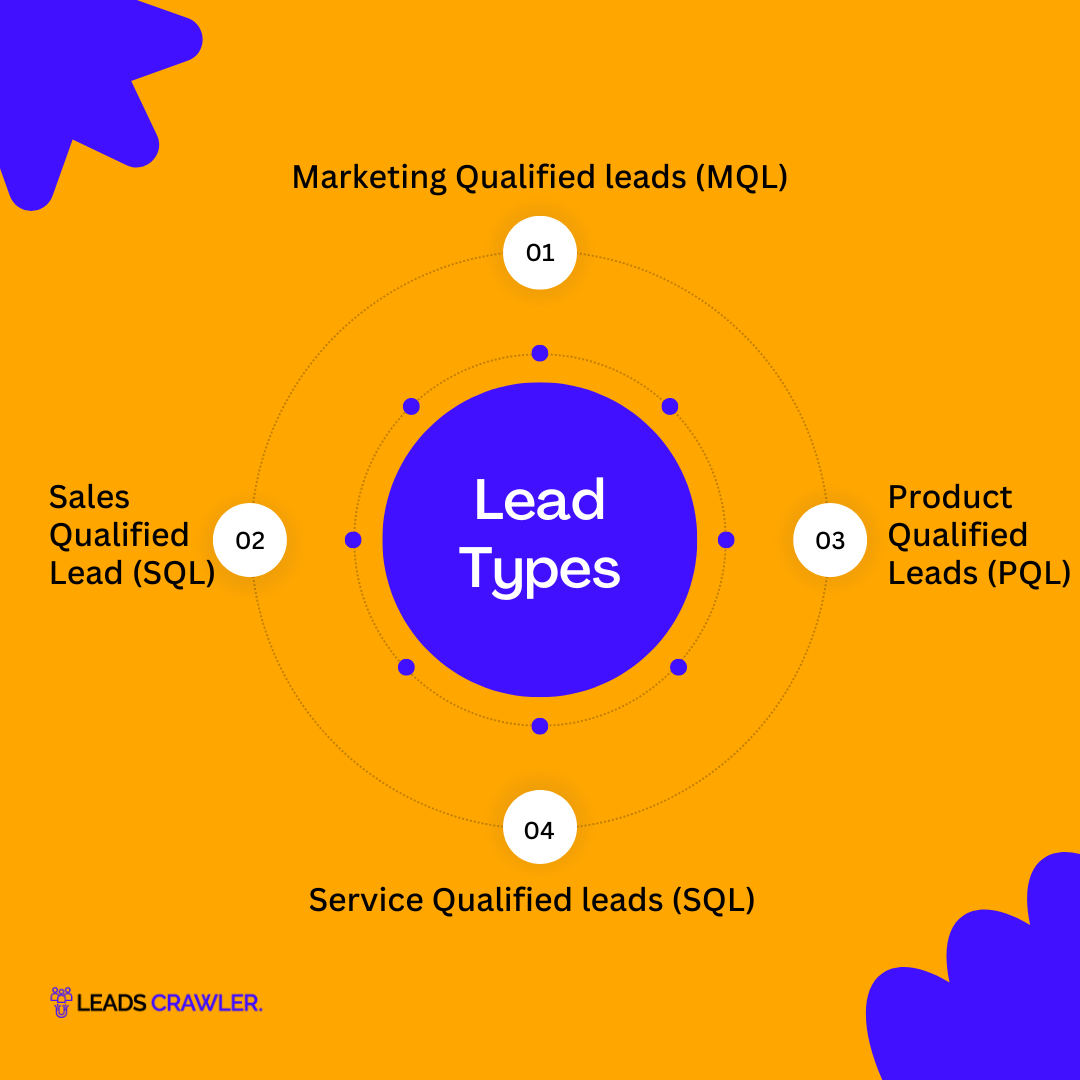
Based on the different marketing prospects and sales lifecycle, here are some types of leads you should take the account for your sales funnel.
Marketing Qualified leads (MQL)
MQL is raw details of a lead that are obtained from a signup form or an offer page. Such customers are not yet ready for a sales call and need to be nurtured.
Sales Qualified Lead (SQL)
SQL is a type of lead that expresses the buying intent of a person. Like someone was impressed with a specific feature of your product during the marketing process and asked for more information. That comes under the criteria of Sales Qualified Leads.
Product Qualified Leads (PQL)
PQLs are established for customers already used a limited version or a free trial of your product. In case they ask a question about the product pricing and extended features for the paid version, this indicates the intent as product-qualified leads.
Also Read: SaaS Lead Generation Strategies
Service Qualified leads (SQL)
This process of the sales funnel includes users showing their interest in the upgraded version. Someone using the free version of the product approaches the support team to become a paid user.
This is called service service-qualified lead, and the sales team handles such queries to channel the successful purchase of the product.
Lead Generation Process
Multichannel marketing efforts are involved in the lead-generation process through social media, blogs, PPC ads, and more. All such campaigns end up with a solid call to action.
That takes the users to a landing page designed to collect specific information. Some people use free resources like e-books, freebies, and free trials. All of your offers must carry some value for visitors to share their details.
Marketing Channels Used In Lead Generation
There are multiple resources used by businesses and marketers in the lead-generation process. Here are some of the most popular methods.
Email Marketing
This lead generation channel is still popular with the best ROI as compared to other resources. You can reach out to the most relevant people in your email list to promote this product.
Blog/Website
Blog websites are some of the best ways to generate leads for your business. This inbound strategy allows you to get the attention of a massive audience. It mainly involves solid SEO investment for long-term returns through search results.
Social Media Ads
Social media channels like Facebook, Instagram, and X are popular among the masses. They have billions of active users with ad personalization features. So, advertise your product to a large number of people with a catchy call to action. Encourage them to visit your landing page.
Events And Webinars
Webinars and physical events like conferences are good ways to promote your product before an industry-relevant audience. If you have a good marketing budget, offer sponsorship to industry-related events and announce free workshops during such events.
Collect the business and personal details of the participants as leads, then offer them product trials on the go. Utilize multiple marketing strategies to promote your product and generate leads.
Referral Marketing Offer
Offer incentives and rewards to your existing customers if they refer your product to more people. Create a separate landing page to collect referral leads and add them to the existing sales funnel for conversion.
forum Communities
Community building can also help you generate new leads and nurture the existing ones. Create a discussion forum within your business website or on social media platforms like Facebook Group, Sub-Reddit, X Community, and LinkedIn Group.
Your existing customers and the people searching for similar products can ask questions. This discussion establishes trust between them with quick feedback.
Search Engine Marketing
Search advertising, usually known as PPC ads, is one of the most common and popular methods for lead generation.
Businesses in every niche use search engine marketing in their diverse strategy. However, you need a high budget to bid in the competitive business categories.
Also Read: Lead Generation Statistics And Trends
Lead Generation Metrics & KPIs: Measuring What Matters
Generating leads is one thing. Knowing whether your lead generation efforts are actually working is another. Without tracking the right metrics, you’re flying blind, burning budget on channels that underperform while missing opportunities to scale what works.
Here are the essential lead generation KPIs every marketer needs to monitor, from TOFU volume metrics to bottom-line revenue impact.
Core Lead Generation Metrics to Track
Not all metrics deserve equal attention. Focus on these seven core KPIs that directly tie lead generation activity to business outcomes:
1. Lead Volume:
The total number of leads captured in a given period. This is your baseline metric, track it by source (organic, paid, referral, direct) to identify which channels drive the most volume.
2. Cost Per Lead (CPL):
Total marketing spend divided by total leads generated. According to industry benchmarks, average B2B cost per lead ranges from $35 to $150, depending on the channel, with organic search typically delivering the lowest CPL over time.
Formula: CPL = Total Marketing Spend ÷ Number of Leads
3. Lead-to-Customer Conversion Rate:
The percentage of leads that eventually become paying customers. This reveals that a channel generating 1,000 leads at 1% conversion is less valuable than one generating 200 leads at 10% conversion.
Benchmark: Average lead-to-customer conversion rates range from 2% to 5% for B2B companies, though high-performing organizations often achieve 10%+ through aggressive qualification and nurture.
4. Marketing Qualified Leads (MQLs):
Leads that meet predefined criteria indicating sales-readiness, typically based on engagement signals, such as email opens, content downloads, demo requests, or specific page visits.
5. Sales Qualified Leads (SQLs):
Leads that sales has vetted and deemed ready for direct outreach. The MQL-to-SQL conversion rate indicates how well marketing and sales are aligned on lead quality standards.
6. Customer Acquisition Cost (CAC):
Total sales and marketing costs are divided by the new customers acquired. This metric shows the true cost of a customer, not just a lead.
Formula: CAC = (Marketing Spend + Sales Costs) ÷ New Customers
7. Return on Investment (ROI):
Revenue generated from leads compared to the cost of acquiring them. According to DemandGen Report, companies that excel at lead nurturing generate 50% more sales-ready leads at 33% lower cost.
Formula: ROI = (Revenue from Leads – Cost of Lead Generation) ÷ Cost of Lead Generation × 100
Lead Quality Metrics: Beyond Volume
High lead volume means nothing if those leads never convert. Lead quality metrics separate signal from noise:
Lead Source Quality Score:
Track conversion rates by source. If your paid LinkedIn ads generate leads that convert at 8% while Facebook ads convert at 0.5%, LinkedIn is 16× more valuable despite potentially higher CPL.
Time to Conversion:
How long does it take a lead to move from first touch to closed deal? Shorter cycles indicate higher intent and better targeting. Track this by channel to optimize budget allocation.
Lead Decay Rate:
The percentage of leads that go cold or disengage over time. Studies show that lead response time matters; leads contacted within 5 minutes are 21× more likely to convert than those contacted after 30 minutes.
Engagement Score:
A composite metric tracking how actively a lead engages with your content, emails, and website. Higher engagement correlates strongly with conversion likelihood.
Channel-Specific Metrics
Different lead generation channels require different measurement approaches:
Organic Search (SEO)
- Organic traffic to lead conversion rate typically 2-5% for B2B
- Keyword rankings for commercial intent terms
- Impressions and CTR from Google Search Console
- Pages per session for lead-gen landing pages
Paid Advertising (PPC, Social Ads)
- Click-through rate (CTR) of 2-5% is standard for search ads
- Cost per click (CPC)
- Landing page conversion rate aims for 5%+ for paid traffic
- Return on ad spend (ROAS) 3:1 minimum, 5:1+ ideal
Email Marketing
- Email capture rate on landing pages and opt-in forms
- An open rate of 15-25% is healthy for B2B
- Click-to-open rate (CTOR) 10-15% indicates strong engagement
- Email-to-MQL conversion rate
Content Marketing
- Content downloads (ebooks, whitepapers, templates)
- Gated content conversion rate 10-20% for high-value assets
- Content attribution: which pieces generate the most leads
- Assisted with converting content that influences deals without being the final touch
Lead Velocity Rate (LVR): The Growth Metric
Lead Velocity Rate measures the month-over-month growth in qualified leads. It’s a leading indicator of revenue growth, more powerful than lagging metrics like closed deals.
Formula: LVR = [(Qualified Leads This Month – Qualified Leads Last Month) ÷ Qualified Leads Last Month] × 100
A consistent LVR of 10-20% month-over-month signals healthy, sustainable growth. SaaS companies often use LVR as a key metric because it predicts future revenue 1-2 quarters ahead.
Setting Up Your Lead Generation Dashboard
Track these metrics in real-time with a centralized dashboard. Here’s the essential stack:
Minimum viable tracking setup:
- Google Analytics 4: traffic sources, conversions, user behavior
- CRM (HubSpot, Salesforce, Pipedrive): lead capture, pipeline tracking, closed deals
- Marketing automation (ActiveCampaign, Marketo, Pardot): email performance, lead scoring, MQL/SQL tracking
- Call tracking: (if phone leads matter) CallRail, CallTrackingMetrics
Advanced attribution:
- Multi-touch attribution platforms like HockeyStack or HubSpot Attribution
- Revenue attribution, which channels and campaigns drive actual revenue, not just leads
Common Metric Mistakes to Avoid
- Tracking Vanity Metrics: Website traffic and social media followers don’t pay bills. Focus on metrics that connect to revenue: leads, SQLs, customers, and revenue.
- Ignoring Lead Quality in Favor of Volume: 1,000 junk leads are worse than 50 qualified leads. Always pair volume metrics with quality indicators.
- Not Segmenting by Source: “We generated 500 leads this month” is useless. “We generated 200 from organic, 150 from paid LinkedIn, 100 from email, and 50 from referrals, with LinkedIn converting at 3× the rate of paid search” is actionable.
- Measuring Activity, Not Outcomes: “We published 10 blog posts,” doesn’t matter. “We published 10 blog posts that generated 250 leads.”
- Short Attribution Windows B2B: sales cycles often span 3-6 months. If you only track 30-day attribution, you’re missing most of your ROI story.
Lead Generation In the Age of AI/ML
Lead generation has become more comfortable with the evolution of automation tools. On the other hand, users can do a thorough search for their required product using social media, search engines, and online communities.
Businesses face challenges with the potential changes in buyers’ interests over time. A strong online presence with inbound marketing strategies is a must to adopt for their survival.
AI and data analysis tools give a deep understanding of potential customers, their demographics, and behavior for lead qualification. With growing competition and the changing interests of customers, it is necessary to follow the latest lead generation trends.
Final Thoughts
In the end, lead generation is the backbone of any business’s sustainability and growth. Through a strong foundation, establishing effective strategies, and integration of lead generation tools, you can connect with the target audience.
Lead generation is equally important for businesses of all sizes to thrive in the competitive market. So, as a marketer and aspiring entrepreneur, take advantage of leveraging your business objectives.
Frequently Asked Questions
Here are answers to the most commonly asked questions related to lead generation.